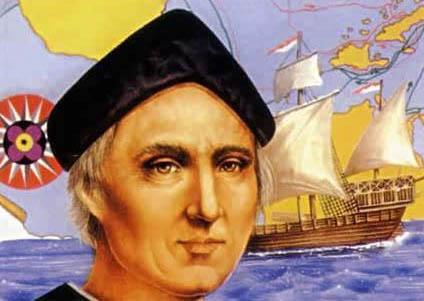
Columbus is one of the most outstanding navigators in human history, and his discovery of the American continent is well known.
Columbus was born in Genoa, Italy to a family of textile artisans. From a young age he helped out in the textile workshop at home. Years of labor and hands-on practice have cultivated Columbus' meticulous, patient character and strong hands-on ability. Genoa is an important and famous port in the northern Mediterranean, tens of thousands of ships berth here every day. The young Columbus was deeply impressed by the people with different skin colors and dresses, the exotic spices, tropical fragrance, all kinds of strange experiences at sea, and the smell of seafood.
Around the age of 14, Columbus joined the ocean as an apprentice sailor. Later, he participated in many voyages to Guinea in the south and Iceland in the north, and accumulated rich sailing experience. In 1476, he came to Portugal by chance, where he learned sailing knowledge. He learned Portuguese and Latin, and used these languages to study cosmology and mathematics essential for navigation, and learned to draw maps and use various navigation tools. After reading "Marco Polo's Travels", he had endless reverie about the richness of the East, so he came up with the idea of going to the East; he contacted the scholar Tuscanelli, accepted his "theory of the circle of the earth", and according to Tuscanelli, Under the guidance of Scarneri "sailing westward, you can reach the country that produces the most spices and precious stones", he boldly made a plan for himself to sail westward to India. He believes that the distance from the Canary Islands to Japan is only 2,400 nautical miles, and to China is only 3,350 nautical miles, which is equivalent to shrinking the earth by 70%.
In 1478, when he peddled his plan to Prince Juan, he may have concealed the key part because he was afraid that his plan would be stolen by others. In addition, he usually talked big and asked for too high a price (a year's supply of food, three ships, etc.) ship, crew, and asked to be knighted, to serve as the governor of the newly discovered place and share 1/10 of all the wealth in the place), so no one believed him, thinking that he was a "bragging king", and rejected his request.
Columbus left Portugal angrily and emigrated to Spain. However, Columbus's plan was in the hands of the Spanish rulers. Queen Isabella agreed to sponsor Columbus's western voyage expedition and signed the famous "Santa Fe Agreement" with him. On August 3, 1492, Columbus led the fleet to anchor and set out to sea. Before long, Columbus discovered the American continent, and the "Baggering King" became a famous navigator in history.