Long before the establishment of the Inca Empire, there was a huge and prosperous city in the Mochi River Valley on the northern coast of Peru. This was also the largest city in South America before the arrival of the Spaniards. This city was the capital of the Chimu Kingdom—Chang Chang ancient city. In the early 15th century, the Inca tribe, who claimed to be the descendants of the sun, took Cuzco in Peru as the center, successively conquered neighboring tribes, and established the Inca Empire. With the increasing power of the Incas, in order to expand the territory of the empire, they conquered the Changchang Kingdom, which had weakened from strength to strength and was torn apart, during years of battles with the surrounding tribes. Decades later, when Europeans came to the ancient city of Changchang, they saw only an abandoned empty city.
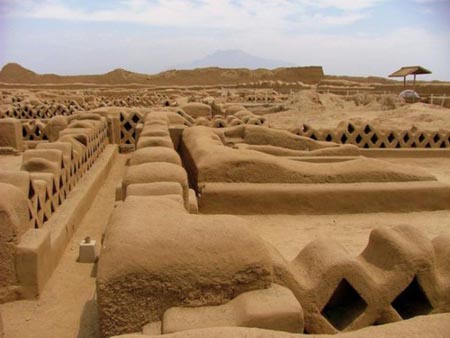
Europeans have not seen how the residents of Changchang lived, they just got some legends about this ancient city from the Incas. Changchang Ancient City covers an area of about 36 square kilometers, with a central area of 6.5 square kilometers, including 10 rectangular castles. Each castle is about 400 meters long and 200 meters wide on average, surrounded by walls 9-12 meters high, the highest can reach 15 meters, and the wall base is 3 meters thick. At present, only a small part of the ancient city has been excavated. Experts believe that there are still most of the city walls and ancient relics buried under the sand and stones, and it will take a long time to excavate them to bring them to light again. Judging from the small portion that has been excavated so far, the ancient city is quite magnificent. Some of the main buildings in the city are made of various earth bricks, which look simple and plain.
As the largest earthen city in the world, in the ancient city of Changchang, there are no stones in the walls or houses, and all are built with earthen bricks. The adobe bricks vary in size, depending on different buildings, and they are "seamless". Earth bricks are often built layer by layer in the shape of a character to prevent damage from earthquakes. Surprisingly, during the Peruvian earthquake in 1970, the city walls restored by later generations collapsed, but the remaining ancient city walls were safe and sound. Later, people discovered that when the Chimu people built this earthen city, their earthen bricks were ground into fine powder with clay, shells, and sand, mixed with water, and then baked with fire. The finished product was purple-red. The fastness is no less than that of modern concrete. Coupled with the dry local climate and almost no rain all year round, these adobe buildings have withstood the wind and rain for hundreds of years. The ancient city of Changchang and its builders, the Chimu people, aroused the strong interest of archaeologists all over the world. Later, some new archaeological discoveries near the ancient city of Changchang shocked the world even more.
In 1987, a series of magnificent pyramids were discovered in the Mochi Valley near the coast. The reason why these pyramids were discovered very late is that they are all made of mud bricks, and the age is very old. Due to the severe erosion, it is almost difficult to recognize them as artificial structures from the outside. The largest one, called the Pyramid of the Sun, has become much shorter due to weathering erosion and damage from treasure robbers. It is now more than 40 meters high. Its base covers an area of 54,400 square meters and looks like a huge earth mountain from a distance. There is a platform at the height of 23 meters of the tower, which is 18 meters high. After calculation, some people believe that an estimated 140 million bricks were used to build the pyramid that year. This pyramid was the largest adobe building in America before the arrival of the Spaniards, and some people think that it was probably the largest man-made building in America when it was just built.